
What is an AI SRE?
An AI SRE is an autonomous, LLM-powered agent that triages alerts, investigates incidents, and finds root causes across production systems without step-by-step human direction. The role is emerging just as AI-generated code pushes operational toil to its first rise in five years. What AI SREs do, where they run, and how to evaluate one.
June 10, 2026
What is an AI SRE?
An AI SRE is an autonomous, LLM-powered agent that does site reliability work across your production tooling without step-by-step human direction: alert triage, incident investigation, root-cause analysis, postmortems, and increasingly guided remediation. Unlike a copilot, which answers only when asked, or a dashboard, which shows data only when someone looks at it, an AI SRE acts on its own. It picks up the alert, decides which systems to query, forms and tests hypotheses, and drives toward a resolution.
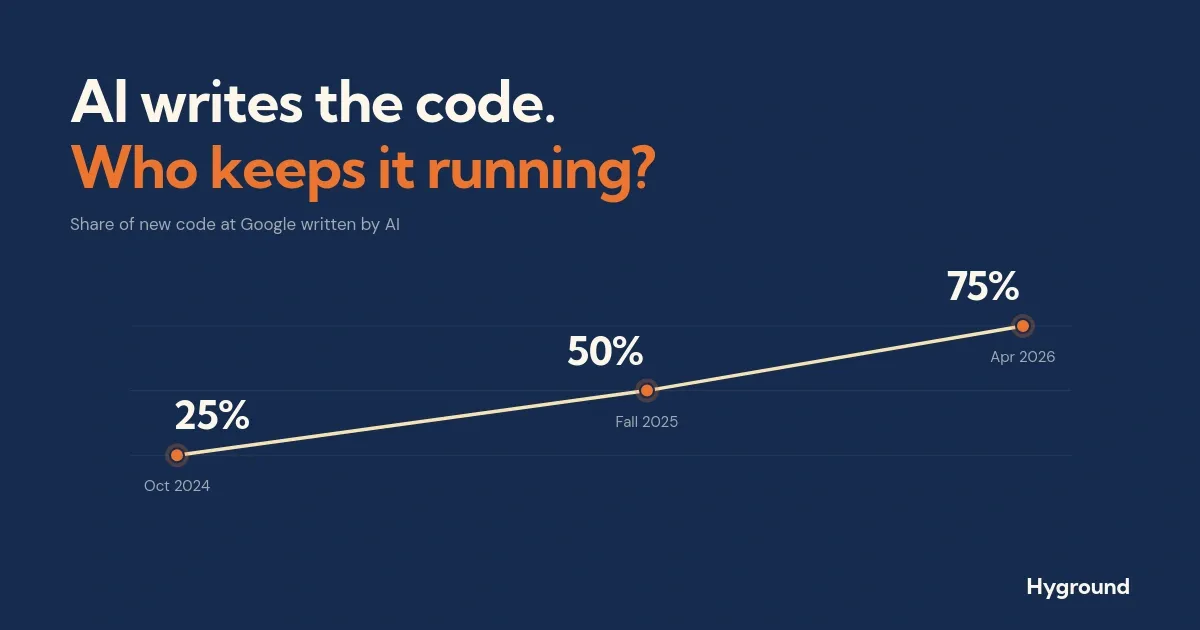
The role exists because of how quickly the way software gets written has changed. In late 2024, Google's CEO said that more than a quarter of the company's new code was written by AI. Within about a year that passed half, and by 2026 it was roughly three-quarters. Google is an extreme case, but the rest of the industry is moving the same way: GitHub Copilot now generates close to half of the code its active users commit, up from a quarter two years earlier, and more than four in five developers say they already use or plan to use AI coding tools.
Why an AI SRE, and why now
All of that code still has to run somewhere, and someone still has to keep it running when it breaks. Writing code was never the hard part. By most estimates, coding is only about a third of an engineering team's time; the other two-thirds is operating what is already shipped: debugging it, scaling it, and getting paged when it falls over. AI has now been pointed squarely at that operational two-thirds. Adoption is broad, and operations teams are following the developers, wiring agents into observability, alerting, and incident response.
The most telling number, though, is the one measuring pain: for the first time in its history, Catchpoint's annual SRE survey recorded toil rising. Median toil climbed back to 20% of engineers' time, up from a record-low 14% the year before, while the broader share of time spent on operations rose to 30% from 25% and time on actual engineering stayed flat. The people who run that survey had expected AI to cut toil, and so far the net effect has been the opposite.
The cause is a feedback cycle. AI writes more code, in larger and less-reviewed batches: an analysis of more than 200 million changed lines found duplicated code climbing and refactoring collapsing, and in one recent year copy-pasted code outnumbered reworked code for the first time on record. That code ships faster and breaks more. Telemetry from 22,000 developers shows the ratio of incidents to merged pull requests more than tripling as AI adoption climbs, alongside a sharp rise in code churn and in changes merged with no human review. Even the teams shipping this code do not fully trust it: close to 40% report little or no confidence in the AI-generated code they release anyway.
So the breakage lands on the same on-call rotation that was already drowning, and the reliability work scales with the code. The catch is that the code is no longer rate-limited by how fast humans can type. You cannot answer an AI-scale increase in toil by hiring people onto the pager one at a time. The only thing that scales with the problem is software, which is exactly what an SRE is supposed to build. An AI SRE applies that idea to the toil itself. The market is moving the same direction: Gartner predicts that the share of enterprises using agentic AI to operate their IT infrastructure will jump from under 5% in 2025 to 70% by 2029.
What an AI SRE actually does
Every credible AI SRE runs the same investigation loop a good on-call engineer runs, just faster and across more sources at once.
It starts with triage: reading the alert, or the hundred alerts, and deciding what is signal and what is noise. This matters more than it sounds, because many outages are made worse by an alert someone had already learned to ignore. Then comes the part that separates a real AI SRE from a wrapper around a chat model: context gathering. It pulls together what a senior engineer carries in their head, from metrics, logs, and traces to Kubernetes and cloud-provider state, recent deployments, architecture docs, runbooks, and past incidents. Telemetry covers only the symptoms, and explaining them takes that surrounding context. From there the agent correlates across the sources, forms hypotheses, and tests them against the evidence. That is the work that today consumes the first thirty minutes to two hours of nearly every incident, usually done by one engineer who is half awake and under pressure.
On remediation, the mature systems are careful. They either recommend a fix and let a human apply it, or, for well-understood and reversible cases, propose the action and execute it on approval. The reckless ones promise full auto-remediation on day one. Almost no team is actually running that in production, so be suspicious of anyone who says otherwise. Afterwards the agent writes the postmortem, covering the timeline, the contributing factors, and the follow-ups, and turns what used to live in three engineers' heads into something the whole team can read.
That loop is the reactive half of the job. The more capable AI SREs do not only wait for the pager; they also do the proactive work that prevents the next incident: mapping the blast radius of a new CVE across your clusters, catching RBAC drift before it becomes an exposure, and analyzing infrastructure cost and right-sizing clusters between firefights. Reacting to incidents is the baseline, and the lasting reliability gains come from the work done between them.
An AI SRE also has clear limits. It does not replace your observability stack, and it does not replace your engineers. It sits on top of the tools you already run and does the work those tools were never designed to do: analyze, correlate, and explain.
AI SRE vs. AIOps vs. the human SRE
The terms in this space get conflated, and the distinctions are worth getting right. AIOps does anomaly detection, alert correlation, and noise reduction over your telemetry. It is useful, but it stops at "this looks unusual": it does not know why something broke, and it cannot act on it. An AI SRE goes further by telling you why and moving toward a fix. It reasons across telemetry and the context around it (deployments, topology, docs, history), so where AIOps produces a flagged metric, an AI SRE produces a root cause and a remediation path. The copilot from the introduction sits between the two: it can reason about a problem when an engineer brings one, but it never acts on its own.
A human SRE still owns the things judgment cannot be delegated for: architecture, capacity strategy, error-budget policy, novel incidents with no precedent, and the call on whether a risky remediation runs at all. The agent takes over the volume of work, and the human stays responsible for the strategy. It is the same division SRE always made between toil and engineering, only now one side of it can be automated.
Where an AI SRE runs: SaaS, self-hosted, or air-gapped
The capability checklists across vendors look nearly identical. The decision that actually constrains fit, especially for regulated and enterprise teams, is architectural: where the agent runs, and what data leaves your perimeter to make it work.
With the SaaS, vendor-hosted model, the agent runs in the vendor's cloud, and your telemetry, logs, and architecture context are sent out to it. The upside is real: nothing to operate, fast onboarding, the vendor handles scaling and model updates. The cost is that your operational data, some of the most sensitive you hold, leaves your environment, and the agent can only reason over what you actively pipe out to it. For teams under data-residency, sovereignty, or NIS2 and DORA obligations, this is often where the conversation ends.
Self-hosting in your own cloud puts the agent inside your own Kubernetes cluster, running beside the systems it observes. Your data never leaves your perimeter, and because the agent sits within the environment, it can reach the full depth of context (cluster state, cloud APIs, deployment history, internal docs) that a SaaS agent never sees. The tradeoff is that you run it, which needs a cluster and a little operational ownership. This is the posture that satisfies most enterprise security and sovereignty requirements without giving up reasoning depth.
A fully local or air-gapped deployment keeps everything, including the language model, inside your boundary, with no external calls. This is what classified, defense, and strictly air-gapped environments require. The tradeoff is model choice: you trade frontier hosted models for local ones and own the full stack. A bring-your-own-LLM design makes this practical without re-architecting.
There is no universally correct answer, and a startup with no compliance surface may rightly prefer SaaS for the convenience. The trend among enterprises is clear, though: because the data an AI SRE needs to be useful is precisely the data they least want to export, deployment posture has moved from an afterthought to the first question on the evaluation list.
How to evaluate an AI SRE
Most tools demo well. The questions that actually decide fit are the ones the glossary pages skip:
- Where does it run, and what data leaves your perimeter? Match the deployment model to your data-residency and compliance reality before you weigh a single feature. It is an architectural choice that shapes everything downstream.
- How much context can it actually reach? An agent that only sees metrics, logs, and traces is doing AIOps with a chat interface. Ask what else it reads: cloud and Kubernetes APIs, deployment history, runbooks, and your documentation. The context it can reach is what sets tools apart, because the model itself has become a commodity.
- Is it locked to one vendor's stack and one model? Open tooling that plugs into the Prometheus, Loki, and observability you already run beats a closed platform that makes you re-instrument everything, and a bring-your-own-LLM option keeps you off a single vendor's roadmap.
- What is its default autonomy, and can you prove it? Read-only by default, with opt-in, reversible, human-approved escalation, is the safe posture. A product that defaults to fully autonomous remediation is a red flag.
- Is it useful when nothing is on fire? A tool that only wakes up for incidents sits idle most of the time. The ones worth paying for also work between incidents, surfacing cost and right-sizing opportunities, catching drift and CVE exposure, and drafting the changes that prevent the next page.
For a side-by-side look at the current tools, see our Top 10 AI SRE Tools 2026 Comparison.
The bottom line
The same wave of AI that writes most of your new code is also creating the incidents that follow from it, faster than any team can hire against. You cannot close that gap by adding people to the pager. What closes it is an agent that does what your best engineer does at 3 a.m.: it gathers every source, reasons about what is happening, and drives to a fix, and it is available to the whole team at once, running where your data already lives.
That is what we build at Hyground: a self-hosted AI SRE that deploys into your own Kubernetes cluster, reads your telemetry and your context, finds the root cause, and stays read-only until you decide otherwise. If AI is going to write your software, something has to keep it running.

Keep exploring
Article
What is an SRE?
A Site Reliability Engineer (SRE) is a software engineer who designs and operates production systems using code, measurement, and automation rather than manual operations. The role was created at Google in 2003 and is now one of the most in-demand titles in software. What SREs do, and how the role differs from DevOps.
Article
Claude Code Is Not an SRE Agent
AI is great at observing production systems but can't replace SREs because root cause analysis requires system history, institutional knowledge, and human judgment that models lack.
Product
Product
Hyground investigates incidents and collects evidence across your systems. Read-only by default, with a complete audit trail for every investigation.